Donaueschinger Musiktage 2010 (1/3)—transparency and risk

The first two days of the 2010 Donaueschinger Musiktage got me thinking more and more about two related words, and how they play out: transparency and risk. Another way to put it might be the turning what is inward, outward. A number of these pieces scatter along an amorphous continuum of transparency, exposure, vulnerability, risk, danger.

In Liza Lim‘s, The Guest, the orchestra’s material seemed to point inward, not just to the solo material, but to the inner workings of the recorders themselves. A vast constellation of orchestral sound circled around the recorder, and the dynamic flow of breath, liquid, energy, within it. It’s natural to associate a compelling presence with instruments capable of producing more sound. But Lim and Jeremias Schwartzer revealed a complex and delicate intensity that was absolutely riveting. The orchestra neither supported nor protected the recorder, but seemed to observe and react as sonic spectators.

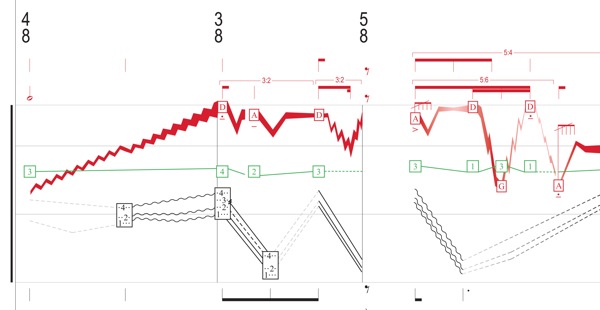
Aaron Cassidy‘s 2. String Quartet is notated in such a way that it overlays each player’s physical motions onto a staff that represents the instrument in one continuous space. A score excerpt will be helpful here:
cassidy-close-up.jpg

The four staff lines are, from top to bottom: bridge, end of fingerboard, top of instrument body, and nut. The shade and thickness of the red line indicates bow pressure, and its placement on the staff shows the point of contact between the bow and the instrument. The left hand notation, in black, follows a similar pattern, also indicating location, finger pressure and, in the case of the wavy lines, vibrato. Bow speed, direction, and region are shown in green. I heard and saw this transparency of motion in the JACK quartet‘s performance. There is an unobstructed flow from score to motion to sound. The JACK quartet read the score fluently and fluidly, bringing out the dynamic phrasing of the work and the currents that lead into and away from a shared body of sound and energy. The entire piece has a luminous, unencumbered quality, and a rich interplay of these streams of activity.

In Alan Hilario‘s slap Schlag, Klaps + stick Stock, the types of action that apply to string instruments are repeatedly and extensively divorced from the instruments themselves, and foregrounded as percussive actions. There was an immense, explosive energy in the JACK quartet’s performance, that went along with a high degree of precision. It referenced slapstick, not just in the title but in some of the actions that you can see in the video below, like the rhythmic air punches between the players. I had a feeling almost throughout the percussive sections of the piece of, “this could be funny, but I find myself taking it quite seriously.” The phrase “benign brutality” seemed to fit with the experience, though it makes no sense in itself. It may have something to do with its combined length and intensity. The whole percussion setup could have seemed like a stunt, but it was done (both by Hilario and by the JACK quartet) with such commitment and intensity that it seemed like a genuine extension of the quartet dynamic. When they did use their instruments, they carried on the gestures of the opening, the rhythms, and the percussiveness. One action that seemed quite representative was an abrupt, muted strumming. The damping of the strings was one of many limitations that demanded maximized effort towards sound production without maximizing the volume. I heard that motion, as well as the abrupt bows and scrubbing sounds, as frustrated effort—very similar to the work the players had to do away from their instruments for so much of the piece, going to similar gestural efforts without being in their instrumental home territory. Near or at the end of the piece, pitch forks brought the percussion-centered and string-centered aspects of the piece together, by first hitting the forks and then using the instruments to make them resonate. It took a tremendous effort and commitment to make the string/percussion integration convincing. It was. You can see a brief excerpt near the beginning of this NMZ broadcast:

The performative situation was turned inside out in yet another way in Peter Ablinger‘s Wachstum und Massenmord. At the start of the first performance, the players had not yet opened the score, and they were to rehearse a portion of it onstage. The rehearsal process is inherent to performance. It drives it and determines it significantly. But it is normally hidden, protected. In this case—on a day that was centered around the phenomenon of the string quartet—it was not. We never heard Ablinger’s “piece,” if by that is meant a front-to-back performance of the score. We heard how the quartets (JACK and Diotima) went about rehearsing the piece. Well, even that’s not completely true. I’ll write another post about how the performances played out and the tangled web of issues, thoughts, and provocations that emerged.
Callithumpian Consort: Ashley, Lucier, Wolff

The Callithumpian Consort performed a concert of Robert Ashley, Alvin Lucier, and Christian Wolff right in my home city of Boston on September 28th. I went to the first 45 minutes of a meeting, and then awkwardly ducked out to get there. I’m very glad I did.

Robert Ashley’s piece, in memoriam…Esteban Gomez was built out of one pitch, its surroundings and outcomes. The transitions were seamless and indecipherable. The tones went further afield from that starting pitch over the course of the piece, but always with the same point of gravity. As a listener I was subtly led away from the singleness of that note, and was surprised at just how surprising the return to it felt at the end of the piece.

Lucier’s Crossings was set up with two groups of players, one on each side of the stage. It might have been partially for that reason that I started to imagine it as a sporting event. But the action was not happening on the stage. It was way up in the air, far above everyone’s heads in Jordan Hall. That is where, to my perception, the tones produced by the players were interacting with the sine tones as they were rising in pitch. The points of friction between the acoustic tones and sine tones produced beating. As the generated pitch rose, more and more players became involved. I had a visual and spatial image of the sounds as particles in the space of the hall. The central action of the piece was the impact and outcomes of those particles. This reaction sounds very subjective, but it is the closest I can come to describing the experience of the piece. It would have been quite different if there were more than one stream of pitches, or there was some other complication of the premise of the piece. But that is a fundamental trait of Lucier’s music: the trajectory is clear, so that the listener’s attention is directed towards the outcomes of that trajectory.

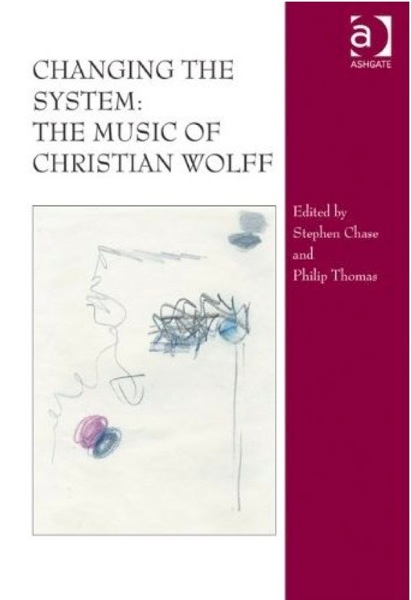
I enjoyed Wolff’s Braverman Music too, and it was quite well performed. I don’t have a clear enough grasp of the piece to say much about it. But there is a book that’s come out recently: Changing the System: The Music of Christian Wolff, edited by Philip Thomas and Stephen Chase, with contributions by lots of people who do have great things to say. I’m very interested to get my hands on a copy.

wolff.jpg

three days in South Carolina

“The really important kind of freedom involves attention, and awareness, and discipline, and effort…. The alternative is unconsciousness, the default setting.” As I drove from Charlotte to Charleston for the first set of events in Michael Pisaro: 2000-2010, a conspectus, I heard that line on the radio from a 2005 graduation speech given by David Foster Wallace, and knew it would be relevant to the events to come. (The speech is reprinted in The Guardian, and it’s well worth reading.) The music I was to hear and think about over the coming days in turn suggests, proposes, and demands new ways of listening, a willingness to listen in new ways, a willingness to not know, to wonder, to actively engage, and to change one’s listening process. There is an open-eyed, open-eared approach to the surrounding environment, whatever it may be.

At one of the events in Charleston, Michael Pisaro posed a number of questions that he considers as a composer.

What is my relationship to the sounding environment?
What, in musical terms, could be gained from a different relationship?
How can you create musical situations that challenge a person to hear in new ways?
What can I do at the limit of what is perceivable?
What would it be like to go to just beyond that point?

Pisaro’s persistently asks these questions in his work, and in a new way almost every time. The installation of ricefall (2): the world of the subsets seems at first to be three hours of one thing: rice falling on various materials. Spending some time in the midst of it, it becomes clear that it is tens if not hundreds of thousands of things in complex relation to one another. A grain of rice impacts a surface. Other grains impact the same surface. Other grains of rice impact other surfaces (including other grains of rice). In the Circular Congregational Church in Charleston, with its rounded ceiling, the combined sounds at times generated very clear, active overtones. The same installation at the 701 Center for Contemporary Art in Columbia sounded so crisp that at times I felt almost terrified that the rice was pouring from the ceiling at one corner of the room. Depending on how the sounds are layered, and also depending on where they are played, the grains of rice seem to take on alternate roles of outcomes of a larger motion, elements, or agents of the entire action. Rhythm and density become one and the same, and take the foreground along with timbre. Another section reminded me of an immense stack of paint splatters. I knew that they were separate layers, but I couldn’t see one layer behind the others. But I knew one had been removed when the stack seemed to be come shallower. Those are just a few examples of my own evolving relationship to this installation as a listener, which I’m sure is distinct from any other listener’s experience of it.

With one exception, there are no specified pitches in the pieces of harmony series. Pisaro described it as “a piece about harmony that does not specify any harmonies…. Harmony is the object, but is left empty.” Harmony becomes, more broadly, relationship, and I found myself hearing shifting patterns of relationship, in aspects like tone, timbre, presence. It was illuminating for me to participate in one of the pieces, no longer wild, at the final concert in Pickens. Though I had spent some time with the score before the rehearsal, I didn’t realize just how crucial one instruction was. One small shift, from “p (clearly audible)” to “pp (barely audible)” staggers among five of the six players and changes the sounding landscape, allowing the barely audible, sustained tone to emerge, gradually and almost imperceptibly. It is this play at the limits where perception becomes the central concern.

fields have ears (7), which was written for this set of events, invites awareness of additional dimensions and possibilities through the construction of a 5×5 sounding grid in the performing space. The players move between the spaces so that each location sounds at some point. The speakers, placed on the outer corners of the grid, pointed upwards and reflected sound off the ceiling, further adding to the dimensions of the sound. My own experience of this piece had much to do with the sense of space that it offered. The spatial and temporal boundaries somehow, in my experience, allowed for all sorts of things to emerge in between—more air, more thought, more pockets of silence. I found ample room to think, discover, recognize, breathe. Those opportunities are precious, in whatever way they are delivered.

The people involved in this series of events made it really special. Greg Stuart and Pisaro have worked together for years now, and they were both involved in the performances. (Ricefall was recorded over the course of many months by Stuart alone. The forthcoming recording is of a 72-minute version, and will be released in mid-October on Pisaro’s new label, Gravity Wave.) The players in the New Music Collective understand this work. It resonates with them, and there is a naturalness and simplicity and unobtrusiveness in their performance of it that to me is an unmistakeable sign of experience and skill. It’s not about “performing” as such, so much as being ready to do something together, to listen, to participate.

As a result of these performances, the discussions, and the works themselves, I got thinking a lot more about harmony and relationships, and how under circumstances like these they become almost one and the same thing. Pisaro told about Ben Johnston saying that there is only harmony when the tones have a clear, numerical relationship to each other. Johnston has pursued tunings that create those proportional relationships. Pisaro takes a different approach. An individual work sets up the potential for a relationship, or harmony, of place, performers, audience, sounds. The listener is invited to be an active participant in the creation of that harmony, through active listening. (It seems to me that this approach is a further extension of the grid proposed in fields have ears (7) into the rows of the audience.) A shared experience that explores these relationships is quite rare and wonderful.