ELISION: transference (3)—Bryn Harrison

I first heard Bryn Harrison’s surface forms (repeating) at its premiere at the Huddersfield Contemporary Music Festival in 2009. Here is part of what I wrote then (and here is the rest):

surface forms (repeating) was a wonderful meeting point (not a compromise) between Harrison and ELISION. The players were in perpetual, rapid motion for the full ten and a half minutes. The dynamic level always stayed low. There was a tremendous tension sustained throughout. And for me, part of the complete focus that it commanded was the continual asking of the question, what is it? The sound world seemed to me to be either microscopic or cosmic in its dimensions. Finally I landed on the image of a tiny nucleus controlling the action of an entire planet of water. The form of the whole is constant and unchanging, but everything within that form is constantly changing. There is a very useful interview with Harrison in the new book edited by James Saunders: The Ashgate Research Companion to Experimental Music. Without quoting too extensively, these couple of sentences about his working process shed some light on the piece I heard on Thursday: “I began to see each bar almost as an area of compression, in which I could subtly contract, expand or in some way distort the rhythms. I would then overlay, combine or link material into longer chains of note values to form whole sections of music or even entire pieces.” It was awe-inspiring to watch any one of the players, but there was no way to get away from the fact for more than a moment that they were operating as a collective unit.

Now that I have the recording, it’s a real opportunity to make some clearer decisions about how to engage with the piece. My own richest experience of the recording is with the close immersion of good headphones. That way, I get the most possible glimpses, fragmentary as they are, of the thousands of details that are slipping past me. I am more, rather than less, bewildered by the piece with each listening, and still cannot reconcile myself to Harrison’s statement below (though I believe him) that the material loops every 40 seconds. The arc and scope of the piece feels much broader than that. There is a flattening of hierarchy between instruments, and the audible surface of the sound is constantly flickering between them.


I had a second chance to engage with a live performance of the piece in March 2010 in London, and to speak with Bryn about it afterwards.

One thing I noticed, looking back at the program note from Huddersfield for surface forms (repeating) was a sort of a set of paradoxes in what you were writing. You talk about “at once both static and mobile,” “providing points of orientation/disorientation,” “drawing a listener into the surface,” where I would usually think of being drawn into the interior, but not into the surface. And then in general there is a circular ways of dealing with time in what is more or less a linear medium. I’m wondering if paradoxes seem pretty essential to you as a composer.

I don’t intentionally set out to make paradoxes, and in fact I don’t think I was aware of the paradoxical nature of that writing either. But I am interested in a sort of putting forth an undefinable quality within the music, something which on the one hand is understandable, has a certain coherence, perhaps even has a certain logic, and yet attempts to transcend that logic as well. So you’re left with both a sense of some kind of understanding, some kind of coherence to the music, but simultaneously a sense of perhaps not really knowing what it is that you’ve heard. So perhaps the paradox comes through. Can it be a paradox without a contradiction?

I think so, and I hear that in your work.

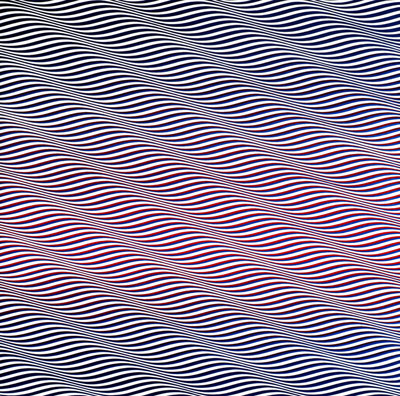
I think a lot of the visual arts that I’m interested in do that as well. If I look at the paintings of say Bridget Riley, the more you look at them, the more there’s a sense of construction of how the thing’s made, and yet at the same time it kind of eludes itself. It transcends the process, if you like. So Bridget Riley in particular talks about how she wants to make colored forms but she doesn’t want to color forms. It’s the result of how things are put together that throws up a sensation of something that hasn’t been painted. I suppose it’s that same kind of thing in musical terms, that you know you can use certain processes. In the case of my music, I sometimes combine, say, a rhythmic process with a melodic process. But the result of that is something which I can’t predict. So as a listener, it still feels fresh to me.
Another thing that strikes me about your music and some others around, is that it’s music that pretends to be less than it is.

Pretends to be less than it is? [laughs]

Yeah. You hear it, and the pitch material adds this layer of, oh, it’s just that. But then underneath, there are all kinds of things happening. I wouldn’t say it’s deceptive in that way, but it’s another kind of contradiction that I hear.

Yeah. There’s that sort of dictum in minimal art where simplicity of form isn’t necessarily simplicity of experience. You can have something that on the surface appears very straightforward, and yet the experience of seeing that work or in this case of listening to music is a lot more complex than it pretends to be, as you put it.

And I’d say too that the construction of it isn’t simple either. There’s a lot of thought that goes into that, and it’s smoothed over in some surface way, but not actually.

Yes, yeah.

I was surprised when I heard surface forms (repeating) the first time. Knowing something of your work from before, and knowing the work that ELISION does in general, to me they seemed like fairly divergent aesthetics. But to me it sounded like you found a true meeting point, like it was really a piece for ELISION and your piece, a part of your work. I’m wondering how you got there.

It was quite a long process, actually. Very often, when I’m working on a piece, it goes through a lot of not just revisions but actually restarts. So from where I start with an idea to where I end is often quite a long process.

Does the beginning have any relation to the end result?

I think so. And I think the pieces always contain the trace of where they’ve been, and perhaps the traces of other pieces before that as well. It’s interesting that very often when I’m working on pieces, I feel that I’m working very much outside my comfort zone and in a very different way, and yet when I hear the results, there’s lots of what I’ve done before in there as well. But I think in this case, the results are quite different, and I think that has a lot to do with, as you say, working with ELISION, and knowing what they’re capable of. So it wasn’t so much that I was thinking about stylistically what ELISION are used to playing, but rather just the potential I had for actually exploring a much more complex surface area, a much more finite gradation of rhythm as well. So you could have the same pitch material going on in several different instruments, but just very, very subtly displaced. So you almost get this sort of blurring effect, this kind of shimmering surface effect. Actually, when I first started writing the piece, I had the idea that it would go through a series of discrete forms, but that things might return, but in a slightly convoluted way. And in fact, the more I worked at the piece, the more I actually realized that what I wanted was just a surface, just a panel that would go on, well, could go on indefinitely. It would go on for ten and a half minutes but would have the sense of being much larger.
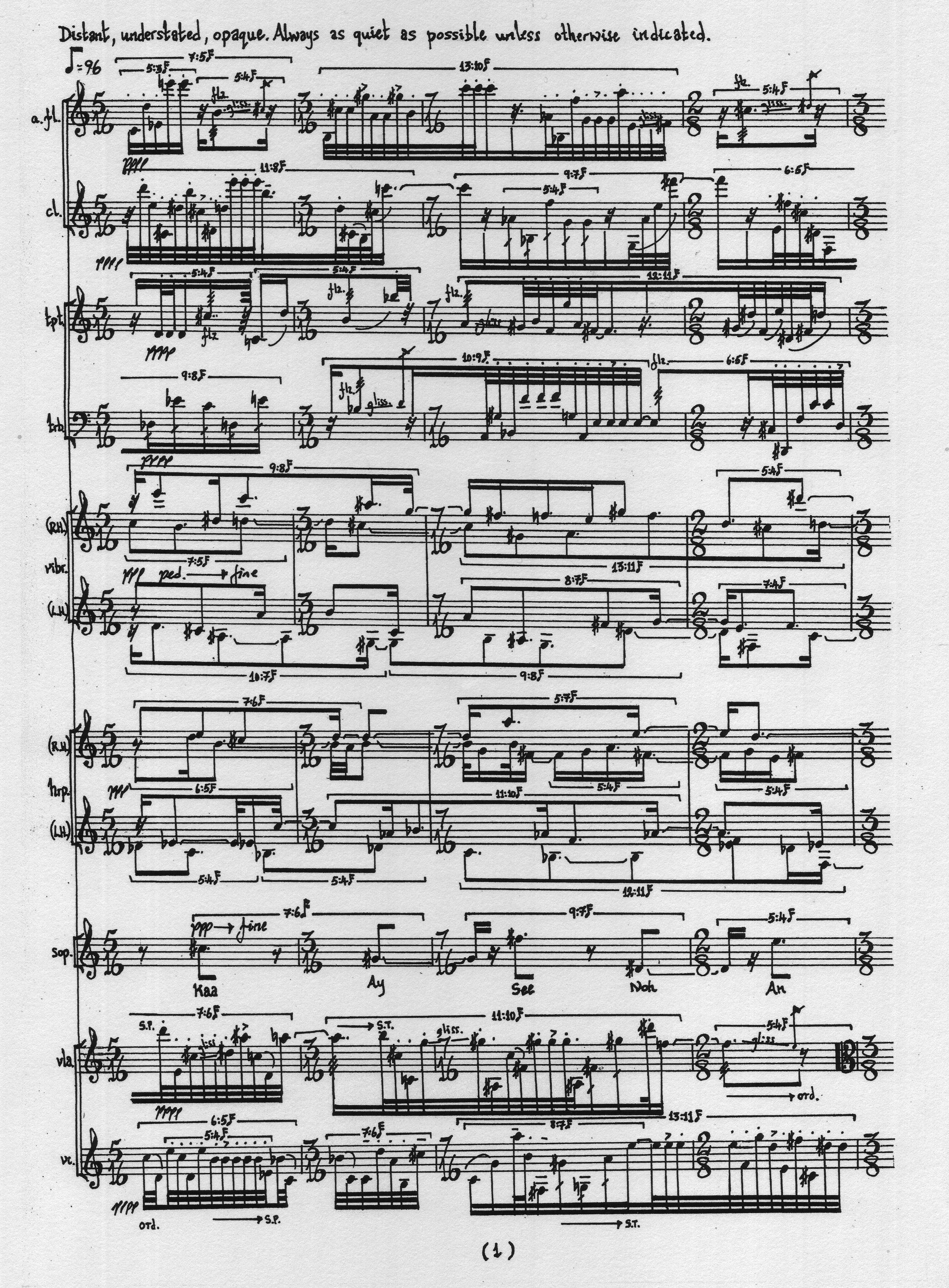
surface forms repeating, page 1

(1′ excerpt)

Yeah, it could have continued. With this group I have the sense that they’re happiest when they’re pushed to this total limit of endurance and concentration.

That’s right, that’s right. Yeah.

And you did that.

Yeah. And in fact, Daryl Buckley, the artistic director, had said, in a slightly joking way, “Give them something to do.” They’ve certainly got something to do in that piece.

Yeah, they have, there’s no question. And the other thing that really struck me being at the rehearsal yesterday was how hard the players were working to not be heard, to not stand out. And that seemed like this additional layer of difficulty. It’s like this perpetual motion, and a lot of activity, but you’re not supposed to hear any of it. It’s part of the larger texture.

That’s right. I mean, it’s all there. It’s a bit like looking at a tree in the middle of summer from a distance. Every leaf is there, and every leaf, and every small twig and branch is all part of what makes up that tree, but you can’t really take too much of that away before it looks like something else. But you don’t actually see the detail.

It’s not soloistic.

No. So I think it’s quite different in that respect to some of the other music that ELISION performs.

Yeah, that’s true. Last time I was at Huddersfield, you mentioned that you still didn’t know how to listen to the piece. I’m wondering if you’ve come to some ways of listening to it, and if your ideal would be to have one way, or a number of ways, or not to know.

Yeah. That’s an interesting question. I think initially, the difficulty I had was that the music’s moving so quickly that it’s very very difficult to get a tangible grasp on anything at all. So I seem to remember coming away from that first rehearsal just feeling a little bit empty, and wondering if the audience would have the same reaction—that you hear this flickering, fluttering surface, but it’s impossible to achieve a direct engagement with the music. And I certainly feel a lot more engaged now, when I listen to that music. But I still find it slightly perplexing, I have to say. I mean, I now know exactly where the repetitions occur within the music.

You can hear them?

Well, I hear them to some extent, but I still find it very difficult to find discernible points where the material repeats in exactly the same way. I should say, when I say exactly the same way it’s pages that repeat but with different articulations, which of course means that when that happens, different instruments come to the foreground. So one of my students actually, Pat Allison, said that for him it reminded him of skip reading through a book. So you’re taking some of the lines, some of the text, and words jump out at you, but you could quite easily come to the same page again, if that was possible in a novel, but not actually be aware that you’re reading the same page again. It’s quite a good analogy, I think, because the material is just so dense that it’s impossible, I think, to hear everything at once. So when we do cycle back to the same points, and the music’s on about 40-second loops, so every 40 seconds…

Only that?

Yeah, yeah. So we encounter the same points about 15 times within the work. But each time, certain instruments repeat, but others might change. But in certain instances, there are actual, literal repetitions of the page. So although the page is incredibly dense, 105 pages, actually a lot of the pages are photocopies or partial photocopies of other pages that are then amended and rearticulated.

How was it, working with the players and with the group? What was that experience?

It was wonderful. I mean they were incredibly encouraging, very very positive. It was a very affirming experience working with the group, and very enjoyable as well. I never thought I would write for ELISION, because I didn’t ever feel that where I was coming from aesthetically complied with the kind of thing that they did. But there was obviously some point of reference there. And yeah, they’ve been incredibly encouraging and supportive.

Did you try things out with them?

No, actually. I think circumstances prevented that a little bit, in that I just had to go away and get the piece together when they weren’t in residence at that time in Huddersfield. So just working with the knowledge of what they did, and to some extent taking some risks as well, I just sort of pulled the piece together.

I don’t think it would have happened without risks. I don’t think it would have worked.

No. But I think that’s something which I always try and do. I always try and work slightly beyond capabilities.


surface forms (repeating) is on ELISION’S transference CD.

ELISION: transference (2)—Liza Lim

Tonight in Amsterdam, MusikFabrik will premiere Liza Lim’s Tongue of the Invisible at the Holland Festival. Now, if I post some of MusikFabrik’s wonderful footage of the collaboration process, I hope you won’t miss the substance of this post: the transcript of a conversation I had with Lim last year.

I’m always fascinated to learn about an artist who is working over the same set of ideas for a substantial period of time. Something has come into their experience that resonates both personally and artistically, and that they find new or subtly different ways to explore from one work to another. It may be precipitated by some serendipitous event, but it continues as a daily choice to continue to work out that relationship between the idea and their work, wherever it leads. Liza Lim has written eloquently in Search Journal for New Music and Culture about an aesthetics of presence which she has been referencing for about seven years now. ELISION’s transference CD includes one early and one recent example of work that has come out of this line of thought, and offers some sense of how rich a field it is in her work.

Lim refers to an aesthetics of shimmer that plays out in Songs Found in Dream, which is an aspect of this overall aesthetics of presence. Shimmer is one of many words that I have thought I understood the meaning of until I looked it up. Various dictionaries refer to a subdued, tremulous, glistening, fitful, or wavering light. It is not just light, but the coexistence or alternation of light with darkness or dullness or obscurity. As she said in our interview, these transitions that interest her “stand for the states which you could call shimmer, shininess, whatever. They stand for a certain kind of attunement, and then states for dullness. Qualities called dullness, veiling, obscurity, dustiness, stand for another part of that attunement in the same continuum if you like.” One type of sound might lead to or even include another, as she goes on to describe in her use of granulated sounds.

Yet another way of conveying this sense of shimmer is through the layering of one thing onto another, using qualities of transparence and opacity as parameters. In the program note to Ochred String, she talks about “moving lines of sound as maps showing the ‘turbulence patterns’ created by the passage of unseen presences.” In her recent orchestral piece, Pearl, Ochre, Hair String, there is ‘guiro’ section that plays against the other sections. In Invisibility, the serrated bow acts as one type of layer and the normal bow as another, in the section in which they both are used simultaneously. The serrated bow itself includes the hair layer and the wood layer, as it is applied to the cello. The serrated playing surfaces used in these and other pieces create vulnerabilities in the resulting sounds. The notated pitches only partially emerge. The obscuring of them is audible, and has this dull quality, but also highlights the vibrancy of the full contact of, for example, bow-hair and string.

Lim’s ideas come through clearly, both in words (as you can read in the interview below, in her Search article, and in Tim Rutherford-Johnson’s article embedded below the interview) and especially in her musical work.

Here is a video of ELISION playing Songs Found in Dream at King’s Place, London in 2010. If you follow the link, you can read further notes on the piece. But it works best to go full screen and pay close attention once you click the play button. It’s wonderful to watch the ensemble, how intensely they are engaging with the sounds from one moment to the next, and how closely they are interacting with one another.

Songs Found in Dream Liza Lim (2005) performed by ELISION ensemble from Daryl Buckley on Vimeo.


We did the following interview in March 2010. Invisibility and Songs Found in Dream are both included on ELISION’s transference disc.

One thing that struck me as I was reading your article in Search is that the intensity and dynamic interactions that are brought out through what you call an aesthetics of presence seem really conducive to the approach you take. It’s a good fit with what you do, that real push and pull. Can you see that sort of approach in your earlier work, before you formulated this aesthetics of presence?

I think it’s all interrelated, in that I’m attracted to certain conditions and certain situations which reflect that. And it may only be later that I explore perhaps its more theoretical aspects or the ramifications of those ideas in a more detailed way. But there are certain things which always provoke this gut reaction that’s very strong in terms of qualities: qualities of intensity, qualities of vibrancy. So I find that in aspects of Chinese culture. I find that in Aboriginal culture. It’s not even culturally specific, but I find it expressed in a number of places. The idea of life force, of the possibility of heightened tension to a threshold state is a cross-cultural thing. But on the other hand, there are some cultures which will emphasize it in a ritual way or paradigmize it, and hence that has led me towards certain explanations. I think to try and answer your question, there is an innate kind of set of conditions I’m really attracted to, and that catch my attention, and which I push my energy towards. So it is an integrated thing. It’s not that oh, I’ve got some intellectual interest in Aboriginal work and therefore I find this thing and I apply it to my music.

That breaking down of those barriers and that interrelatedness seems crucial, and you really welcome it in. Now that you’ve found this and stated it so clearly and seen this clear correlation, do you think that it’s going to be a part of your future work?

Oh yeah, definitely. I’d been working with the Aboriginal cultural ideas and so on since 2004, 2005, and that’s connected to just serendipitous meetings with Aboriginal artists and my next door neighbor when I was living in Brisbane—so again, a very organic process, when you’re led from one thing to the next. And I don’t see such a clear division between the different areas that I’ve explored in my work. It’s not like, oh here’s the Sufi part of me, and here’s the Chinese part of me. You know, they’re actually all perhaps speaking to the same thing in a way. And I suppose in relation to that, I would say fundamentally the music is about pointing to that experiential space rather than the music being even the primary thing in itself. So the reason for being engaged in music is in order to be in contact with those kinds of very heightened states, rather than necessarily defining myself as a composer working with certain materials, that kind of thing.

Yeah, the music as a vehicle to…

Yeah, that’s right. You’ve put it exactly.

And how does this aesthetics of presence manifest in Songs Found in Dream?

Well that was actually one of the earlier pieces in that sequence of work, which was written deliberately as an exploration of this aesthetics of shimmer. And not only shimmer as a sort of positive quality of shininess and vibrancy and oscillation, but the way in which that is veiled. There’s also an aesthetics of obscurity and an aesthetics of dullness. So there’s a whole dialectic between states as well, and transitions between states that I explored in this piece. And that’s important to me. What’s important is the fact that there is a landscape in which there are these transitions happening, rather than it being about any particular state. They stand for the states which you could call shimmer, shininess, whatever. They stand for a certain kind of attunement, and then states for dullness where one moves away from a clear attunement. Qualities called dullness, veiling, obscurity, dustiness, stand for another part of that attunement process in the same continuum if you like. So that’s the basis for the language.

That’s really clear. That really maps onto what I’ve heard, too.

Yeah, so to be clear, it’s the functional qualities of that. There’s a system of relationships which is what I’ve adopted, rather than any kind of surface characteristics of, say, aboriginal music or whatever. And that’s always been the level at which I try to look at cultural references, also Chinese music. It’s those kind of subterranean structures. You can work with it more, I think, as an artist, when you’re looking at that level.

Yeah, getting right in there. And do you find your approach has shifted over these last five years or so?

Well, it’s just that you learn more how to move around, and it’s a continual process. I feel like I’m just starting.

And how it shifts must have something to do with the performers you’re writing for as well.

Sure, yeah. Different opportunities come up as well, so you find different ways of, as you say, mapping a set of ideas into situations. A solo piece has obviously a certain kind of scope as opposed to working with a larger scale ensemble or orchestra. And I just finished writing this orchestral piece [Pearl, Ochre, Hair String] which takes as its starting point Invisibility. It actually incorporates, to a small extent, some of the material of Invisibility, not so much directly, but in terms of technique—so the serrated bow, the guiro bow…


Will multiple players have those?

No, there’s a soloist. Well, there’s a sort of guiro section. So not only are there sections of winds, strings, brass; there’s a guiro section, which is two percussionists playing serrated instruments of various kinds, a solo double bassist who is using a rasp stick (so that’s a serrated stick), and then the cellist also with a serrated bow. So it’s become like a category, its own section of sounds.

It plays that way in Invisibility too. There’s the one bow and then the other.

Yeah, which really dramatizes the differences between those modes of playing. So the thing in the orchestral piece is that it’s a quality of sound. What I find really interesting about those kinds of sounds as well as any other sort of granulated sounds like rattles, where you really hear the graininess of the sound, is the quality of being both solid and liquid. It’s flowing, but it contains these very distinct and articulated elements as well. And so that in-between quality is something I’m always looking for in my work, because it can therefore take on more of the properties of the liquid, or more of the properties of the solid. So you can move in a number of directions—that’s how I think about it.

I’m not sure if there’s a question in here, but we’ll find out eventually. It’s striking to me that those transitions between are so important, that it’s this moving to that, but that in your life experience and your work, there’s a very clear transition and integration that seems really essential to how you’re operating as a composer. I don’t know if that’s something that you’ve sought out, but it’s also been serendipitous, finding those things that work.


I think that, in a sense, to me that’s the whole project—to become more integrated in your life. Don’t you feel that about your own work?

Oh, absolutely.

Isn’t it of a piece with who you are and who you want to be?


For more on Lim’s work, take a look here at Tim Rutherford-Johnson’s article in INTO magazine.

ELISION: transference (1)

Over the coming days, you’ll see a succession of interviews relating to transference, the second CD on the Huddersfield Contemporary Records label, played by the ELISION ensemble.

I’ve done interviews with all of the composers on the CD, as well as one of the performers. There is far too much material and background to talk about in a single post. Even in six, I’ve barely scratched the surface. I hope you’ll enjoy the interviews, and I can’t recommend the CD itself highly enough. The production values, the result of a partnership with Radio Bremen, are stellar. The compositional voices are distinct and rich, and the performers of ELISION pursue their intentions with rigor, skill, and an unmistakeable, total commitment.

For those of you who may not yet know about ELISION, or for those who want to know more, here’s an excellent profile of the ensemble by Tim Rutherford-Johnson published in Sound and Music’s INTO magazine. It starts on page 30. Their next concert is scheduled for July 15th at the City of London Festival.