aperiodic (3), aperiodic (4)

aperiodic is a wonderful new concert series in Chicago, curated by Nomi Epstein. She says:

For me, it came out of a number of things: my appreciation and enjoyment of that music, and my seeing that I didn’t have the option of sharing a lot of this repertoire in Chicago. On top of that, I have experience with curating and putting together concerts, and I’ve done it before, so it’s something I knew I could get off the ground at least a little bit. But it was the kind of music that I wanted to hear and be a part of in performance, and to create a venue for it. A lot of my colleagues are in different parts of the US and Western Europe, and they are making this music happen, but it wasn’t really happening here.

I attended aperiodic (3) on May 22nd, and participated in one of the pieces: Jürg Frey’s more or less normal. It’s an enlightening process to study, rehearse, and play a piece, rather than just glancing at the score and seeing how it happens once. In this case, the question that everyone brought to the first rehearsal was about how to match the metronome markings. Should we keep some device going with a silent pulse in front of us? The markings ranged from 40 to 69, and changed often enough to cause some insecurity. Word had come from the composer not to worry about it, but to approximate them as best we could. I for one knew that my approximation would not be a good one. All the players are start together, but each in a different part of the score, and are to end at a different point in the score as well. Because of the tempo changes and varying lengths of the sections, it would be quite difficult to calculate exactly how parts should align, if performed perfectly according to the metronome markings. What I’m sure of, is that we never aligned the same way twice. But that in itself is fascinating, that the relative durations of each part changed so dramatically. Each person’s perception of time, and the relation between the results of those perceptions, shifted according to some indefinable mix of internal and external circumstances. It is not about a perfect execution. It is about a concerted effort, and the variation of results from that effort.

There is a similar and more explicit interest in the variability of perception in Joe Kudirka’s canon, which involves pitch matching between the players: “There should be no planning or coordination as to what the pitch(es) should be – there are no wrong notes. A player simply makes an educated guess as to what the pitch to be imitated is, and plays it – no wavering.”

Matt Sargent’s Tide for nine sliding instruments has five types of action—rise, fall, sustain, return, silence—for each of the nine sliding instruments. It all seems so simple and so natural, and yet like the Frey it sets up a complex set of interactions. Epstein, who participated in the performance, reflected,

Similar to the Frey piece, this one is dependent upon relationships between instruments, this time the relationship being that each player ends their glissando at a pitch point that they hear within the ensemble. They must always listen while playing/singing, and the ending pitch they find may be heard at any point during their 10 seconds of noise. It is nearly impossible to keep that pitch in one’s head while multiple glissandi are going on around you, and all the while you are also glissing. Similar to the Frey, it sets up a nearly impossible feat of trying, trying, and knowing you are probably failing, but in a most beautiful way.

Mabel Kwan’s performance of Kunsu Shim’s Intermezzi #2 and 3 brought out wonderful resonances on what may not be the most forgiving of pianos. The wrist and hand motions and finger changes brought out sound transformations which I don’t yet understand, but will continue to explore.

Chiyoko Szlavnics’ Acclines had a real tension. Maybe it was because I had seen the line notations of the score, but I felt a real tension of coherence around each unison or quasi-unison. The closest analogy I can find is of several people on the same tightrope.

Mirror, by Cristyn Magnus, was very funny, not because it encouraged comedic performances from the players (it did not), but because it set up a kind of a game of sonic matching. It needed some time to reveal itself, but there was a palpable shift in engagement in the audience as they began to understand the laws of play in action.


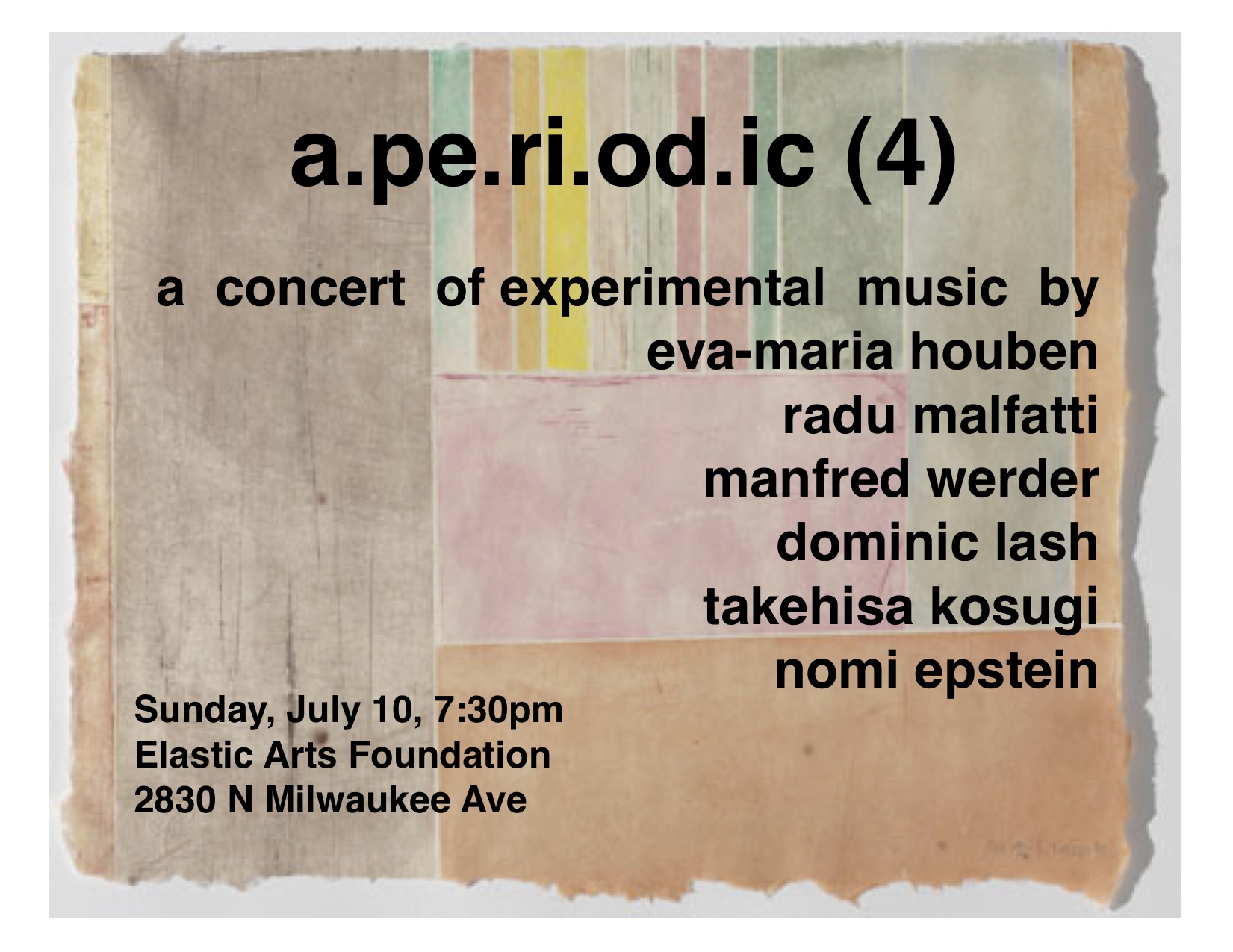
The program for the upcoming concert on July 10th includes:

Manfred Werder: stück 1998
Dominic Lash: from four to fifteen*
Nomi Epstein: Text Series
Eva Maria-Houben: pismo beach*
Takehisa Kosugi: Distance for Piano
Radu Malfatti: sprachlos

*world premiere

There is a nice symmetry in the return of Werder’s stück 1998 to Chicago, since one of the earliest performances took place there. I heard pages 647-652 in New York several months ago. The history so far of the “one successive and intermittent performance” of the piece is fascinating, as is the direct, subjective experience of any portion of it. Several thousand pages remain to be performed.


And here is footage of a performance from the first aperiodic concert, Antoine Beuger’s rain/east wind/ocean, played by Lee Weisert and Nomi Epstein, the two founders of the series.

three drops of rain/east wind/ocean by Antoine Beuger/Aperiodic (1) from Aperiodic on Vimeo.

ELISION: transference (5)—Mary Bellamy

In Mary Bellamy’s transference, on the ELISION CD by the same name, cellist Séverine Ballon always seems to be at play with both the surface and the underside of the sound. The sounds themselves have real beauty, and an indescribable coherence from one to the next. Bellamy wrote about exploring, with Ballon, “the subtle ways material can be altered depending on the combination of playing techniques used.” There is constant variation of timbre and effect. The sounds seem incredibly delicate, and yet they travel into unexpectedly bold and even fierce territory, and I find it impossible to trace how they got there. It’s not a simple transition, but it’s as if the power of each sound is hidden within the knife-edge of its earliest appearance.


We spoke last year about her experience with and around the piece.

You had a quote on BMIC [now SAM] where you talked about placing material in a space. [“When I am writing a piece I find I am most concerned with its shape and that, although there is a lot of detail within the musical material, the architecture of the piece takes precedence. I work with an imaginary sense of the space the piece will occupy and composing it becomes a process of placing material into that space.”] It seemed like your approach, based on that quote, starts from the outside and works in, but the approach towards transference was very much related to Séverine’s playing and worked from the inside out. Was that a conscious change, or was it dictated by the circumstances?

I’ve done a few collaborative projects, and I think that has changed the way I work a little bit since what I wrote in the BMIC website. So it wasn’t really a conscious choice. I suppose it was just a result of starting the project from a collaborative angle that changed the way that I worked there. But I do much prefer to work in that way rather than starting from outside.


Oh really, so is that a change generally in your working method?

Yeah. I’ve been trying to find opportunities to collaborate, ideally.

So that’s really a preferred starting point, with the player and with the circumstance.

Yeah. I’m still happy to write pieces where I don’t get to work with the performer, but I just find it a much more worthwhile and enjoyable way to compose, to have contact with the instrument and the actual player. 


I do as well, actually. You started to address this, I think, in the [CeReNeM] blog posts. Was there some idea of the space that you wanted to occupy in this piece, of what the overall shape was, or was there something sort of going in before the meetings?

Not at all actually, no. I did have a few sketches, but I don’t think we ended up really looking at them in the first meeting. Really it was just, Séverine was showing me a lot of different sorts of sounds that she could get, multiphonics, some prepared cello sounds, and different bowings. So it was really just trying to find sounds that I might want to develop into a piece. So although I had taken some sketches along, it didn’t feel like the right time to start looking at those in the first meeting.

And once you had some sketches, after meeting for the first time, were there some things that you had from the beginning that stayed intact?

Yeah, there was the opening of the piece which has stayed the same throughout, probably since our second meeting. I wrote quite a long stretch of the opening material, and that sound has basically stayed as the opening. But everything else has really changed a lot. I’ve reworked the material a lot, and changed the structure. It’s been a really different way of working, I think, hearing things back in real time and being able to go away and restructure them.

Beyond the very specific techniques, what was the impact of Séverine’s playing on the piece? Was there something broad-scale that you wanted to bring to it from what you knew of her playing?

I think it’s very hard to pin-point what that is. I think her playing has had a big impact on the piece, and the way I thought about the cello when I was writing it. I’ve never heard her improvising, but she does do a lot of work as an improviser. But I purposely didn’t want her to improvise in our sessions anyway, because I didn’t want that to influence…


Oh, so you didn’t want that direct influence, so it was more looking at, what about this and this sort of sound?

Yeah. But I think in her improvisation she tends to focus on quite quiet sounds, subtle sorts of sounds, multiphonics and things like that, different sorts of bowings which bring out different distortions. And generally my pieces are quite subtle, and do focus on quite quiet material. So I think there was a sort of connection there anyway.


Yeah, there was a good meeting point. Are there other things you wanted to talk about in relation to the piece or how it happened, where it went, surprises in that whole process?

Well I think it did make the compositional process quite different for me, because I had the opportunity to try out so many things. So often if I don’t have the opportunity to keep meeting up with the performer, I might focus on one very specific type of material. But this, I think, has given me more scope to try a variety of different ideas, although I think it’s quite unified in the end.


But it took that process to get there, and to be able to say, what if you took this in this direction? How would it work?

Exactly, yeah. I rewrote the piece about four times, I think, with different materials that haven’t actually made it into the final one. But I’ll probably use those in other cello pieces, because I have quite a lot of further ideas that I didn’t think would belong in this work, but could belong in another work.

Was there anything that you were just completely surprised by, for example that just had no idea that the instrument could go there, or that you would go there?

I’m not sure about that, actually. I think I was always really daunted about writing a cello piece, about the idea of writing a cello piece, because there are so many great, iconic works for solo cello. I wasn’t sure if the sorts of sounds that I generally work with would suit that instrument, but I think that’s maybe what surprised me is how, working with Séverine, I’ve been able to find the sorts of sounds that I didn’t really think I would be able to work with on the cello. There’s another thing that I found really interesting about the whole process. We’ve worked so closely together on the material, and Séverine has been playing through bits of it, so she kind of knows all the content, virtually. But when I gave her the finished score and she went away for a month to work on it and then came back, it was just really astonishing the way that she’d shaped the piece, and that she’d brought so much more, or she communicated so much more through the material than even in the sessions when we’d been working.

So you kept on discovering the piece…

Absolutely, yeah. It’s amazing though, the way performers have that ability to communicate a piece, to shape it.


transference is available on the CD by the same title, through amazon.co.uk and the University of Huddersfield online store. A portrait concert at this November’s Huddersfield Contemporary Music Festival will include three pieces by Bellamy: new work for solo cello, Séverine Ballon, new work for solo bass flute, Richard Craig, and new work for contrabass recorder and cello, Genevieve Lacey and Séverine Ballon. The solo cello and solo flute works have been written in collaboration with the performers.

DARK MATTER

Last year, I was in Prague for the first major retrospective of my current favorite artist. Each of my three visits to the exhibit brought about simultaneous feelings of exhilaration and an almost unbearable sadness, knowing that the full experience would likely never be available to me again. I took notes and gathered all the supporting materials available, but really the best I could do was try to take in the exhibit as best I could and let some strong impressions wash over me.

The circumstance that brought this memory back so vividly was the very recent surfacing on YouTube of Yvonne Mohr’s video about the installation-performance of DARK MATTER in Berlin 2003, involving Richard Barrett, Per Inge Bjørlo, and the ELISION and Cikada ensembles. Watching those 35 minutes of footage of the installation, performance, and interviews made me ache to have been there, and in some way to feel as if I had been there. Daryl Buckley, ELISION’s artistic director, makes the point in the video that the piece is elusive, and that “there is no one correct perspective” from which to hear it. The texts, as Barrett says, “bear upon … the evolution of humanity’s relationship to the reality that exists around us, the cosmos and so forth, and also the relationship that human beings have … with their own unconscious self.” These topics can only be addressed in a fragmentary, suggestive way. It’s not out of keeping with the nature of the project to try to piece together the fragments of a fresh experience of DARK MATTER.

The basic information about the piece is here. Other resources available include the score, available for perusal from UMP, substantial sections of the piece available on the transmission recording, an interview between Buckley and Barrett that was included in the MaerzMusik program notes, Keith Gallasch’s account of the Brisbane Powerhouse performance, Richard Toop’s article, and other related interviews here and here. (What have I missed?)

And the newly available video is right here: