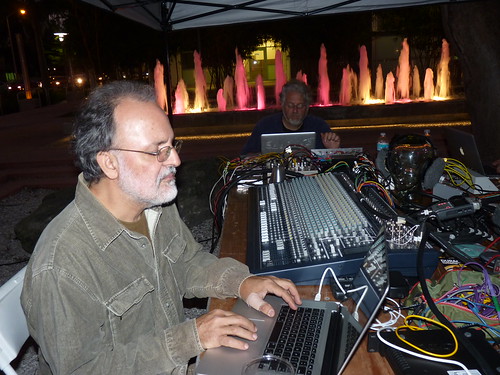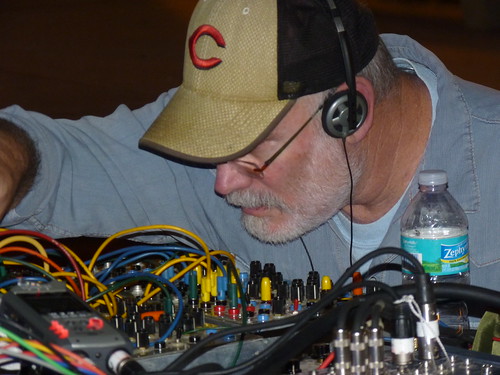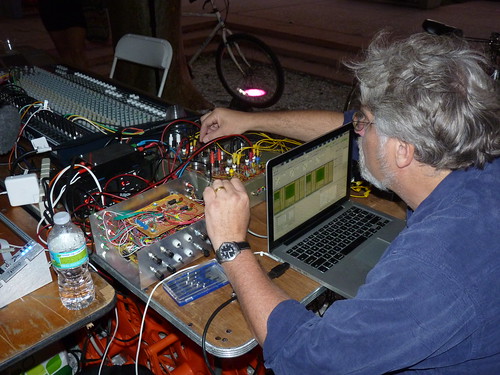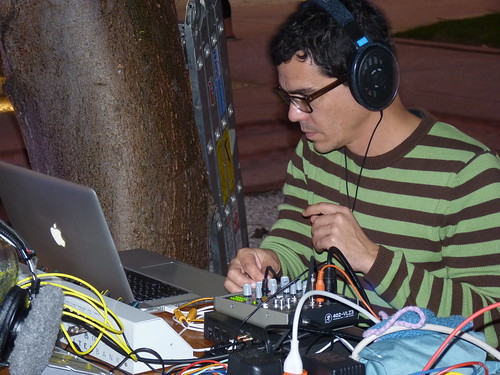
Within the context of a Frozen Music installation, I learned once before that the listening experience doesn’t have much to do with individual sounds or moments. What is fascinating is how sounds and systems interact and what they bring out in each other. David Dunn refers to a “collective fabric that is infinitely variable and to which we all remain attentive.” Late in the performance, I listened as two of the performers returned from a short break. The whole body of sound shifted in an indescribable way. There was no single new type of sound but a deeper field of interaction. It was like a complex chemical reaction that no one, including the performers, could expect to decipher.
The hundreds of curious passers-by and the many who stopped to listen were witness to the fact that this was, without a doubt, a compelling body of sound. It was louder than the traffic, and formed a sort of protective cloud with no clearly defined enclosure. My own experience of Miami is bound up with the Subtropics festival and Frozen Music, and I would be very curious to hear how this kind of installation would transform my experience of an environment more familiar to me in day to day life. I have no doubt that it would.
On a technical level, some of sounds result from the interaction of analog circuits, drones, live signals, prerecorded audio, and extracted resonances. These elements really do interact in complex and often indiscernible ways with each other, with the surrounding environment, and with the listeners. To offer the most basic of examples, at one point I thought I heard a car horn. That interested me, because even though I was very close to a busy intersection, I had not been hearing any of the traffic go by. So I tuned in to that horn, and it went on and on. I don’t know whether that car honked at the time I heard it and was recorded and prolonged, if it was a prerecorded sound, or if it had never actually been a honk but was another sound that I associated, because of all the cars going by, with traffic noise. For another extended period of time, it sounded like the motion of a current in some way evoked a set of reactions that had a vocal quality (squeals, squeaks, remarks).
Sitting in the plaza for most of the 8-hour installation, I loved seeing how other people reacted to the event. Of the hundreds of pedestrians who walked by (this event took place during Miami’s Sleepless Night), no one failed to turn their head. A cab driver across the street stuck his head out the window to better hear what was going on. One woman sat down and started meditating. Others would sit on a bench between two of the speakers for hours, listening. Some long conversations took place in the midst of the space, and surprisingly did not seem either to interfere with or be disrupted by the installation. If anything, the nature of the sounds fostered a deeper level of engagement. Other people would stop and ask, what is this? or, what’s the point? I would point them to a sign that included David Dunn’s explanation: The Sound Practice of Frozen Music. The final sentence reads, “Whoever or whatever passes through our web, or stops to listen, is welcome to make use of the sounds in whatever manner may please or excite them.”
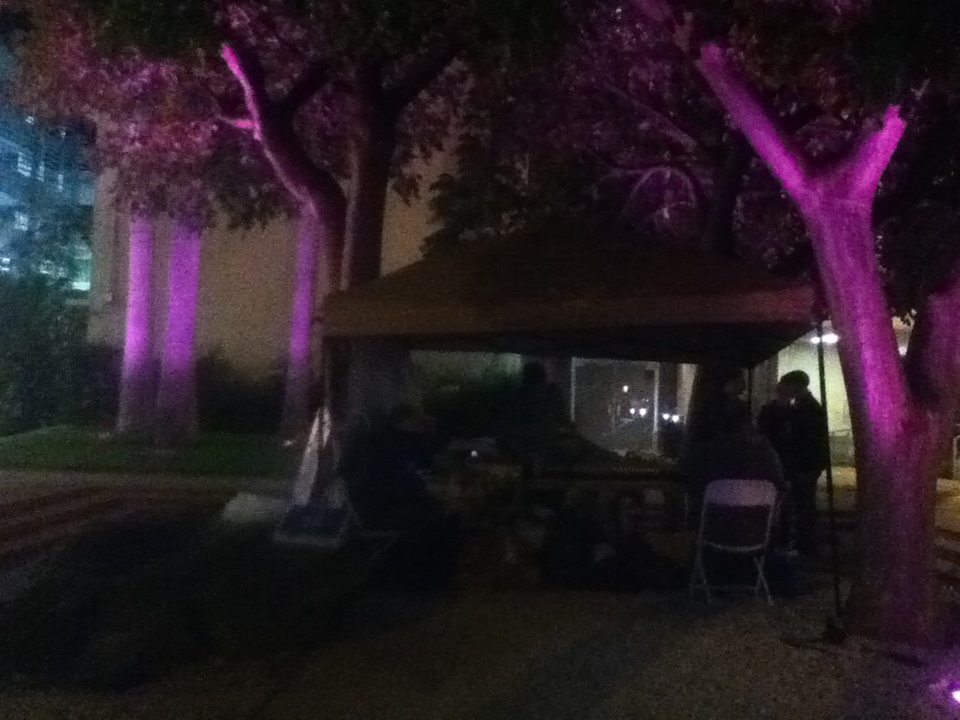
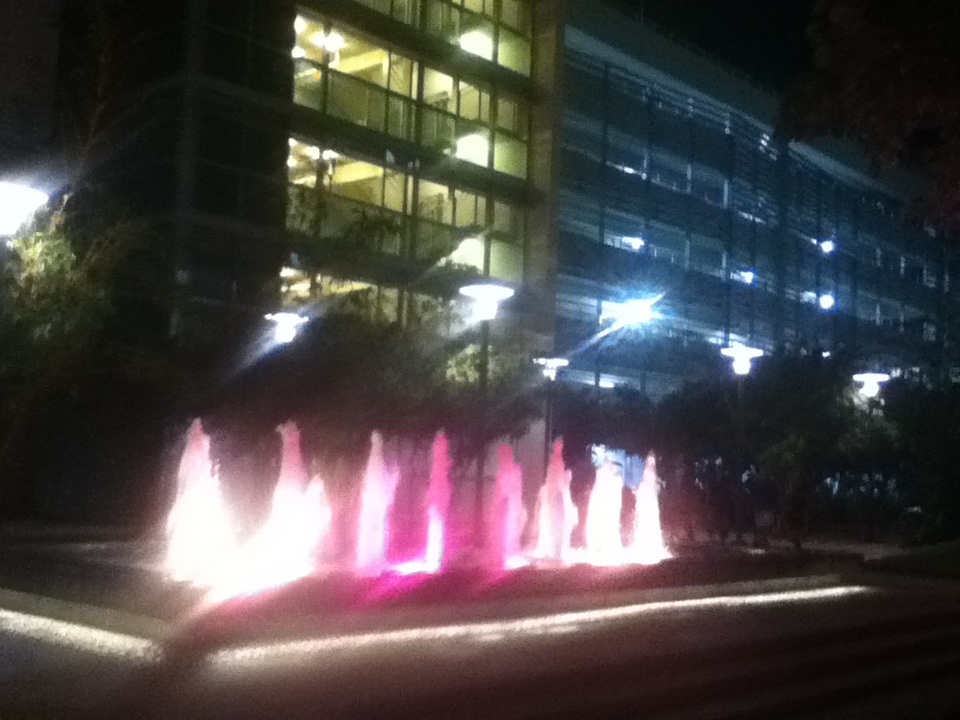
The following four photographs of the ensemble members (and guest) were taken by Stephen Malagodi. The last two, poor quality photographs are my own, just to give some sense of the setup and lighting.