December radio broadcasts

There are loads of interesting programs this month. To find out more about how to access them, take a look at the radio page. Also on that page, there’s a form for suggesting any programs that could be added to the list.

December 6

Stefan Prins portrait
00:05-01:00 GMT+1

Porträt Gerhard Stäbler: “HörkunstPerformanceKonzert”
21:00 – 22:30 GMT+1

December 7

Mayako Kubo und Petros Ovsepyan
21:04-22:00 GMT+1

December 8

Morton Feldman
00:05-01:00 GMT+1

Hebräische Klänge
20:00 GMT+1
Czernowin: ‘Zohar Iver’ (Blind radiance)

December 10

CODEX-MELBOURNE
22:30-00:30 GMT+10

December 11

Deutsch-polnische Orchesterwerkstatt
Oscar Bianchi, Rebecca Saunders, Gorden Kampe, Agata Zubel
European Workshop of Contemporary Music
23:05-00:05 GMT+1

December 12

En direct du Théâtre de la Ville : John Cage
Ear for Ear, Antiphonies (1983)
Etudes Freeman livres I et II (1977-1980)
Four Solos*
Etudes Freeman livres XVI et XXVII (1977-1980)
Four 2 (1990)
One9, nf 8 (1991 ; Ext.)**
Hymns and Variations (1979)
20:00-22:30 GMT+1

December 13

” … um Musik und Menschen in Bewegung zu bringen”
Zur Aktualität von Cornelius Cardews “Treatise”
00:05-01:00 GMT+1

December 14

attacca 2011
Alvaro Carlevaro: “14 unbemalte Bilder”
23:03-00:00 GMT+1

December 15

Christian Wolff
00:05-01:00 GMT+1

December 17

From Scratch
Huddersfield Contemporary Music Festival 2011
Frey, Parkinson, Parsons, Saunders, Wolff
22:30-00:00 GMT

Zwischen den Sinnen
Die Schweizer Performerin und Komponistin Charlotte Hug
00:05-01:00 GMT+1

December 19

Neue CDs
23:03-00:00 GMT+1

December 21

attacca 2011
Matthias Schneider-Hollek: “betting on the muse”
Keiko Harada: “deadline”
23:03-00:00 GMT+1

December 24

From Scratch
Huddersfield Contemporary Music Festival 2011
Frey, Parkinson, Parsons, Saunders, Wolff
22:30-00:00 GMT

December 25

Mauricio Kagel
Phantasiestück (1989)
Pan (1985) für Piccolo und Streichquartett
23:05-00:05 GMT+1

December 27

Mauricio Kagel
21:00 – 22:30 GMT+1

December 28

From scratch (Basel performance)
Jürg Frey: Louange de l’eau, louange de la lumière (UA)
Tim Parkinson: Orchestra Piece (2007) (UA)
Michael Parsons: Paraphrase for Orchestra (UA)
James Saunders: things whole and not whole (UA)
Christian Wolff: Spring Two (UA)
22:30-23:55 GMT+1

attacca 2011
Oliver Schneller: “WuXing / Metal”
Adriana Höszky: “High way for one”
Marko Nikodijevic: “GHB / Tanzaggregat”
23:03-00:00 GMT+1
Listening Gallery, Miami

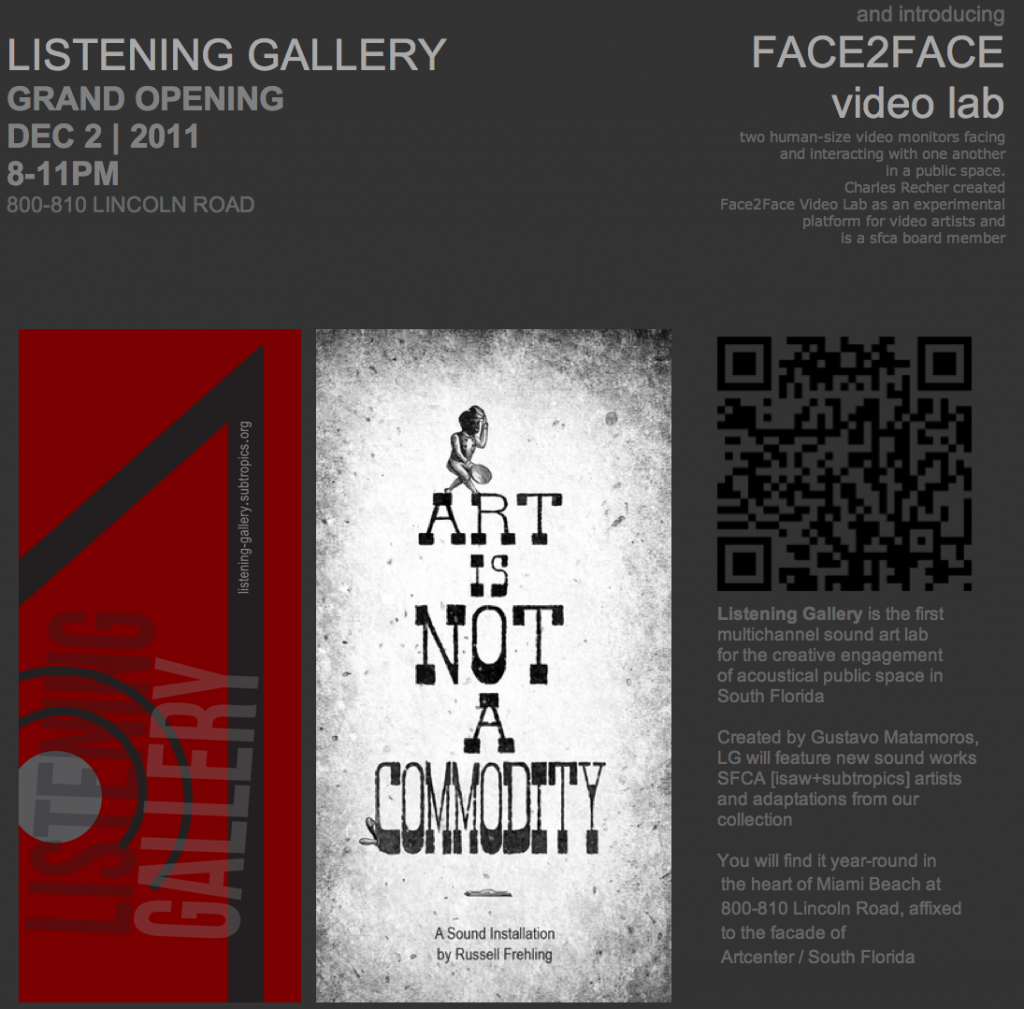
The Listening Gallery, a project masterminded by Gustavo Matamoros, opens tonight on Lincoln Road on Miami Beach, and will continue into the future. I was there for the soft opening at Sleepless Night for another installation by Frozen Music. The sound transformed my whole sense of that space, and it was fascinating to watch passers by stop in the space to listen. The site is a 16-channel system installed under the awning of ArtCenter South Florida, spanning the southwest corner of Lincoln Road and Meridian. More details about the current installation are below. I’ll write more about the whole project soon.

Art Is Not A Commodity (A Sound Installation, Miami Beach, 2011)

For this installation specific sounds from the surrounding ambient noise are recorded then digitally encoded. From these samples extremely short segments, a few thousandths of a second long, are extracted and looped in such a way as to render them essentially static instantaneous slices; the way that a photograph has the ability to freeze a subject in motion. These waveforms are distributed along a line of twenty loudspeakers that form a soundfield along two faces of the Artcenter 800-810 buildings

I’ve further distilled from these waveforms only the uppermost spectral components. What is left are these delicate ethereal timbres which have been inconspicuously layered on top of and interact with the real-time ambient noise in curious and unpredictable ways

Russell Frehling, Nov. 2011

Artist’s Statement

“My installations are essentially works of sculpture with sound employed for its physical ability to occupy and define space and function in three dimensions. Here sound is given an unaccustomed context in which its physicality becomes the essential issue; where shape, texture, density and arrangement in space become the objects of reflection. The materials and structure for each piece are drawn from the “available” ambient sounds and physical properties inherent in each site: the sound of the work is the sound of the place. By distilling from the surrounding ambient soundscape the marvelously complex waveforms and natural resonances and putting them in a dynamic relationship with their environment, the observer is given a unique opportunity to respond more palpably to the sonic material and the space it occupies

BIO

Russell Frehling developed an early fascination with sound and music. He made his first professional recording at the age of twelve, an experience which sparked his continuing interest in the use of electronic technologies as creative tools. Frehling was awarded the Reiner Prize for music composition from Brandeis University where he received his B.A. in 1974. Following a period of study with Pauline Oliveros and Morton Feldman he was invited to the Center for Contemporary Music at Mills College earning an M.F.A. in Electronic Music under Robert Ashley and David Behrman

His relationship with sound has taken several forms over the years: composer, engineer, sculptor and eco-activist. In the early 80‘s as part of a project for Greenpeace, Frehling spent two winters in Iki, Japan developing an underwater sound system designed to alleviate the conflict between dolphins and fishermen competing for the same resources. He has received a number of commissions from both the public and private sectors: New Music America, the Houston Astrodome, the Bienal (Sao Paulo, Brazil), the Hartford Civic Center, NMA/Center for the Fine Arts , the Sterling Building Project, and several Art in Public Places projects. As an audio engineer he has been involved in many significant recordings and sound projects

hcmf 2011—CONSTRUCTION (1)

An easy review of ELISION’s premiere of Richard Barrett’s CONSTRUCTION on Saturday might be one of superlatives and single-word descriptions. I would include a reference to the astounding energy, technical capacity, and musical intelligence of the members of the ELISION ensemble, which is in fact nothing less than that, and is not to be taken for granted. As descriptions of the piece, words like epic and monumental have been used to good effect.

The challenge of talking about this piece in fact mirrors the premise of the piece itself. As stated in the program notes, “The principal “theme” of CONSTRUCTION is the relationship between idealised “utopian” cities and real ones.” The approach above is the utopian one. While it’s accurate as far as it goes, it says nothing about the multidimensional reality of the piece and of Saturday night’s performance. What actually happened?

At the outset, I can think of two ways in:

1) Research about the piece. The program notes, the list of sections, Barrett’s comments on the radio broadcast, and ultimately the score. The passages referenced, most particularly the foundational Francis Bacon quote from The New Atlantis, which I just found and which illuminates the piece for me:

We have also sound-houses, where we practise and demonstrate all sounds, and their generation. We have harmonies which you have not, of quarter-sounds, and lesser slides of sounds. Divers instruments of music likewise to you unknown, some sweeter than any you have, together with bells and rings that are dainty and sweet. We represent small sounds as great and deep; likewise great sounds extenuate and sharp; we make divers tremblings and warblings of sounds, which in their original are entire. We represent and imitate all articulate sounds and letters, and the voices and notes of beasts and birds. We have certain helps which set to the ear do further the hearing greatly. We have also divers strange and artificial echoes, reflecting the voice many times, and as it were tossing it: and some that give back the voice louder than it came, some shriller, and some deeper; yea, some rendering the voice differing in the letters or articulate sound from that they receive. We have also means to convey sounds in trunks and pipes, in strange lines and distances.

2) Experience. Hearing the piece again. Going back and remembering the experience of hearing it live. Hearing from others about their experiences of the piece, whether they be from the vantage point of a participant, an audience member, or one of those who has tuned in for the broadcast from anywhere else in the world. Online so far, I’ve found two items: a brief but positive reaction at The Watchful Ear, and The Rambler‘s thoughtful beginnings of a consideration of it. Tim Rutherford-Johnson starts his post by writing, “I wasn’t there last Saturday, in Huddersfield Town Hall at the dead of night. So I can only write a compromised response to a partial experience.” I was there on Saturday, and I had the chance to hear a complete run on Friday. But I can fully echo the second sentence. The run, the performance, and listening to the broadcast have been three completely different experiences for me. What I may end up with, then, when I do start actually writing about the piece, is a compromised response to several partial experiences.

I’ve just returned home from the Huddersfield festival, and this is the first chance I’ve had a powerful enough internet connection to listen to the radio broadcast, which is available through Saturday evening. I feel some urgency about posting something while the piece while the broadcast is still publicly available. What I’ve said so far does not even scratch the surface. But looking over the next few days, it seems unlikely that I can respond to the piece in a substantial way before next week.

So while the broadcast is still available, I want to open up the field to hear from those who have engaged with the piece. Answers to any of these questions might be a good start. Where were you when you heard it? What next step would you take, if you could, towards a fuller experience of the piece? What was compelling about the performance? What were your most powerful impressions of the work? What connections did you draw between the music and the referenced texts?

You may have a question of your own, or a response to a better question. It’s useful to get it down while the experience is still fresh and the broadcast is still available.